Is Your Dog Being Stubborn?

Very commonly when working with clients, they say their dog is being stubborn. We are trying to do something new with the dog that the dog has never done before. A surprising amount of people think the dog is being stubborn and knows what to do but chooses not to do it.

This is actually a big reason why Force training back in the day caused a lot of issues. People would automatically jump to “the dog is stubborn.” So then they would add consequence. But if the dog didn’t actually know what to do, you could run the risk of breaking spirit in the dog.

So here are a few things I tell clients to help them determine if their dog is being stubborn:

  1. Rule of 33 – Three things you ask here.
    • Command – Has the dog done the command before?
    • Distraction – Has the dog done the command at this distraction level before?
    • Distance – Has the dog done the command at this distance before?

      The command is usually yes. The dog has done the command before, such as sit or down. But the other two things matter a lot. Has the dog done sit or down at this particular distraction level and distance? If they never have, then I do not allow myself to say the dog is being stubborn.
  2. Body Language
    • Small – Ears back, tail low, licking lips, blinking eyes.
    • Tall – Ears perked, tail up posture forward

      If you also see body language as small with ears back, tail low, licking lips or blinking eyes, that is a sign the dog is being respectful but doesn’t understand what you are asking.

Some of the increases in difficulty, such as a bit of distraction and distance, seem inconsequential to us, but they are a big step for the dog. I have a name for this. We call it “University Professor Syndrome.” You know how some people are super smart on a subject, but terrible at breaking it down for others? It’s because they never struggled with it so they have a hard time understanding how to break it down for others.

You will often find the best teachers on a subject were the ones who struggled with that subject.

So I give people this analogy. Once I go over all of the training with them, which there is quite a lot to know, I tell them: I now want you to teach this to others at an expert level, otherwise I think you are being stubborn and we are going to shock you. The clients start to get the point then. Then I say, even if I went over this 3 times with you, I now want you to teach this at an expert level, otherwise I think you are being stubborn and we are going to shock you. They are still thinking, they likely don’t know it well enough after 3 times. However, if we went over it 33 times, then yes, they likely know it quite well.

Point being: When you increase any distance or distraction, it resets the Rule of 33 to 0. It can mess the dog up again. You may need to break things down again for them to understand. Some dogs will be sassy and bark. They might have all their body language up. But that can merely be out of frustration. The key thing is the Rule of 33. Have they done the command before 33 times at this new level?

I really learned this when I thought they were being stubborn too. So what I did was say they were only getting fed their meal if they did as I asked. Soon you would see drool pouring out of their mouth. You could tell they really wanted it, they just didn’t understand. As you got closer, they would then get it. That is when the lightbulb really clicked for me. I thought about the University and College profs I had that were clearly very smart on a subject but absolutely terrible at breaking it down to be understood. Luckily I had another very smart friend who was good at figuring things out and breaking it down for me. She didn’t understand the profs either and they could not break it down for her. But she was smart enough to figure it out.

Consequence

Because here’s the thing. If a dog is being stubborn, consequence is what solves that problem. But if you add consequence and the dog actually doesn’t understand, you do run the risk of breaking spirit like they did back in the force training days. That’s why I tell clients, you can’t taser toddlers for not peeing in the potty when they don’t understand. But a 25 year old guy peeing in public places is not likely to get retraining from the police with gummy bears.

Relating

Maybe I can relate better to dogs as I often feel like a dummy on everything new I go to learn. It always feels like I run into issues that no one else has. Or it just doesn’t click for me. But once I learn it, then I can explain it very well, as I seemingly have run into all the issues and figured out the problems that overcome that issue.

Plus Side to Being Slower

If a dog doesn’t catch onto patterns quickly, there is actually a plus side to that. Those dogs are less likely to develop aggression issues. The smart dogs that catch everything instantly are way more likely to develop aggression issues. We relate it to horsepower. The more brain power (or horsepower), the more likely you will have a wreck in the future. So when I work with clients, I tell them I prefer the dogs that take a bit and then understand. It is pretty incredible to see the range at how fast or slow some dogs are at catching onto patterns.

So give your dog a chance. They likely just don’t understand and you need to break it down for them. This is the main thing I help clients with. The dog is at A and clients try to jump to D. So I teach them how to break things down so the dog can understand and build up to the level they want.

If you need help learning how to break things down. Contact me at Tyson@DogSquad.ca or 403-877-3006

Best Dog Trainers Calgary

The best dog trainer for your situation might be different from someone else’s situation. So let’s help you determine which ‘dog trainer is best for me.’

Types of Training:

  1. Train the Human – Out of all the styles of training I have tried, I have found the biggest success for people is to ensure the human gets trained as quickly as possible. Training a dog is all about leading the dog. When the human knows how to lead, the dog quickly follows. You learn how to assess problems and solve them on the fly. Training dogs was easier to learn than training people. You can give someone a fully trained dog and they can unwind that training if they do not know how to lead. So I have spent years perfecting how to convey to people why things are important to do. Essentially, you try and teach a human and then you see what mistakes they make. Then you see how many humans make the same mistakes. Then you try to assess why they are making this mistake and what is the missing piece of information that helps to overcome that issue.

    As one example we found certain puppies were a lot more common to develop aggression later in life. Looking back at the notes I keep on clients, it was always the puppies that learned patterns extremely fast. Not just fast, extremely fast. About 8 to 12 months later we would have clients say their dog was becoming aggressive to other dogs or people. So we learned to tell clients about the “evil genius” category. When a pup would learn a certain command like laying down to a standing hand signal in under 10 minutes we would tell them their pup is falling into the “evil genius” category. Doesn’t mean they will become aggressive later in life, but the odds do go up a lot. Then we would instruct them on what to watch for and how to deal with it. Ever since then, the emails about aggression later in life have dropped to nearly zero. There have been many things like that where we have learned to better help the human understand what to watch for and how to solve the issues.
  2. Board and Train – People love this idea. Send the dog off and someone else does all the work. Then they get this fully trained dog and can just enjoy the dog with no issues. The biggest issue we found here is that you send the dog to someone that knows how to lead. But then goes back to someone that doesn’t know how to lead as well or at all. Even when you teach the humans what they need to do, most would not do what they needed to. It would be like getting a brand new house but thinking you never need to maintain it. Or how about a special machine where a personal trainer could take over your body, eat healthy, exercise and get you into shape. Then hand your body back over. But then the person thinks they can eat junk food and not exercise anymore. The human hasn’t learned the core skills and why they are important.

    The smarter the dog, the more likely you would still encounter issues later on after the dog went back home. If the dog was slower to catch onto commands, they were less likely to challenge when going back to their human.

    We found it was better for the human to go through dog training and work towards their goal. Then they could hit the same wall the professional dog trainer would hit. Then we could tell the client again what they needed to do and why they needed to do it. Once they did that, they would overcome that wall. It just seems to ‘stick’ so much better for the human when they see why something is so important to do.

    One of the most interesting stories I heard of a dog being trained by someone else was a guy that bought two professionally trained German Shepherd guard dogs. Took his private jet to Germany and paid $100,000 for the two dogs and brought them home. Later on the dogs attacked a Fed Ex employee so he sent them out to a farm he had. The dogs went and killed all the neighbor’s livestock. The human needs to know how to lead.
  3. Group Class – This was the first thing I did when I started. You can learn the basics. But essentially you could learn this on YouTube real fast. Two main issues here. One is that you cannot focus on each person’s issues. You kind of have to stick to the program to get through it. Secondly, the trainer usually has to focus the most on the person that does the least amount of work when they go home. If you are doing your work, you get the least value. This is also why I like the clients that do the work. Then I can teach them everything they need to know right away, and then they can achieve their goals exponentially faster.

    It is common to have a 6 week basic obedience class. I find you can teach a puppy that is 10 weeks old their basic obedience in 3 days tops. They usually learn their basic obedience on day one at 10 weeks old. Usually you get the pup around 8 weeks, so by 10 weeks they already know their basic obedience. I tell people putting a dog through a 6 week basic obedience class is like keeping a kid in Kindergarten for 6 years.

    Or to put it another way. When I go to help a client with a 10 week old puppy, the pup learns the basics in minutes. We immediately move onto advanced obedience where the pup is learning how to do commands to a distance, how to hold the command and how to do it around distractions. You can have a puppy trained to a higher level than most people have seen a dog trained to, before the pup is even old enough to enter most basic obedience classes.
  4. In-Home Training – The thing that is nice about in-home training is that you have the trainer focusing on just you. In the house is what we consider Kindergarten level of training. Which most dogs will master in minutes. Then you need to go look for distractions. The reason why I like having clients come to our place now for training is that we have distractions on hand. Chickens, horse, cats, etc. We can immediately go there and start running the pup through distraction training. Otherwise, in the clients neighbourhood you might waste a lot of time trying to find distractions to train around. Then those distractions also need to be under control for safety. Where in the city can you find small animals to train within 1 foot of? Or where can you find a large animal like a horse to train within 1 foot of?

    If you want a dog to be trained at a distraction level, you need to train them at that level. I tell clients that hardest part of training a dog is finding or setting up distractions to train around.
  5. Training in-home with the human at work – I also did this and it was like board and train. However we found clients could unwind the work you did during the day. So keeping the dog for longer during board and train worked better as you could give 100% consistency. But as you already read above, the human still needs to follow through to maintain the dog.

Overall you can see the theme here. It isn’t really dog training, it is human training. Every time I train a client to assess problems and solve them, you can see the lightbulb go off in their head. They get it. It is way more human training than dog training.

So this is why I think if you are looking for the “Best Dog Trainer in Calgary” or Best Dog Trainer in Red Deer, Edmonton, Alberta, BC, etc. I help people from all over. I’ve had clients drive out from Vancouver Island, Nothern Alberta from 12 hours away. Saskatchewan from 9 hours away.

The training is setup as a half day session. Train the human first. Then we start training the dog. We can see how quickly the dog learns and what problems we encounter. It gives us a pretty clear picture of what to expect moving forward. If the human has any issues, I tell them to email me and I will run them through what needs to be done. It isn’t a dog training problem. It is a human understanding what to do problem.

So then I figured if it really is a human training issue. Why not train the human as fast as possible? Would taking 6 weeks to train the human be best? I found that answer to be no. Of course there are all the issues and questions they will have along the way. So why not just give them a clear picture right from Day 1. Does the human need to remember everything? No. I send a detailed notes email after the session to give them a clear picture of what needs to be done for specific problems. There is also access to the members area that goes over all of the videos and notes in detail for certain obedience and problems. I also tell the client to email absolutely any question. Let’s get you understanding immediately what needs to be done. Then I also tell clients to send a progress report every 7 days or sooner if they want. Then I can see what the human remembered and what problems they hit in specific so we can address those issues.

I will reiterate and explain things differently as many times as needed until the human understands. One key technique is not just to tell a client how to do it right, but you also tell them how to do it wrong. Then the lightbulb goes off for a lot of people. It is called ‘teaching in contrast’. That is essentially how many children’s books teach children.

If you want your dream dog as quickly as possible, I can help you achieve that. I absolutely love seeing clients achieve that high level success. Where random strangers come up and tell them they have never seen a dog so well trained. Or I love getting clients where they say they saw this dog that was so well trained and they ran up to the person outside to ask where they went for training and they say they went to see Tyson at Dog Squad.

To get your dream dog, contact Tyson

403-877-3006

Tyson@DogSquad.ca

Fear Issues From COVID Lockdowns

We were expecting to see more fear related issues when the lockdowns happened with COVID and we did see a very large increase in fear cases as suspected.

Pups go through a socialization period from roughly 5 to 12 weeks of age. Whatever they see during that period and have a good experience with they tend to like later on. Whatever they have a bad experience or just no experience with, they tend to not like later on. This is why I can’t even count how many times I have had clients tell me they think their dog is racist because they only bark at black people or elderly people with walkers, etc. It largely has to do with what types of people the puppy saw during that socialization period. I have even had clients tell me their dog was racist towards white people because they lived in a neighbourhood that had virtually no white people living there.

During COVID when people were social distancing and just not going out to do as many activities the dogs didn’t see as many different things and people. Interestingly we even saw a number of pups that had been socialized as a puppy prior to lockdowns and as they got a bit older and there was more social distancing they still developed fear issues.

The 5 to 12 week mark is approximate and there are still a lot of variables at play. Some pups go through that socialization phase faster and some are slower. We see a number of Lab puppies and if we show them a horse at 8 weeks of age they sit there like a potato and don’t care at all. At 10 weeks they will be a little bit cautious. At 12 weeks even more cautious. At 16 to 20 weeks you are likely to see fear barking if they haven’t seen a big animal like a horse before.

What happens if a pup is fearful? Some will get scared and hide. Others will become reactive with barking and growling and can escalate to aggression where they attack things they are fearful of.

The biggest predictor of which way the pup will go is how quick they are at pattern recognition. If they are slow at pattern recognition in training they are more likely to be the type to run and hide. If they are very fast at pattern recognition then they are more likely to become reactive and aggressive.

The Aggression Issue – Many trainers these days advocate for reward only. Every technique has its own set of pros and cons. The problem with reward only training is that rewards are good at rewarding behaviour. Many of our clients who have dogs with fear issues have gone that route and made the fear reactivity worse because they are unknowingly rewarding reactive behaviour. We tell clients that it is like trying to drive your car everywhere with only the gas pedal. You are going to have a wreck.

There are a lot more variables at play to solve these issues. If you or anyone you know has this issue you can contact us to help you solve this problem. We teach clients how to understand the variables and modify their dogs behaviour for the better. It is common to have 2 fear related issues that get solved differently. So what works for one dog may not work for the other. As you see hundreds of these cases you start to see where the dogs group. As we put the dogs through some training scenarios we can quickly see where they are going to group and how quickly they will overcome the issue.

Contact us: Tyson@DogSquad.ca

Website: www.DogSquad.ca

The Most Important Dog Training Tool – Thinking

There are a lot of variables when it comes to training dogs. How quick a dog catches on. How much desire they have to please. What motivates them. What they dislike. The list goes on.

The point being, dogs differ. You will come across all different kinds of problems and you have to think your way through those problems.

The other part of thinking is taking all of the information you hear out there about how to train a dog and think, does this make sense? What are the pros and cons to this method, tool or ideology?

Training a dog is all about communicating effectively to your dog what you want them to do and also what they should not do for various reasons including their own safety.

One of the more recent things to enter dog training ideology is to not say “no” to your dog. That one has me baffled as to how anyone could think that is a good idea. That takes away about 50% of your ability to communicate. There are really 2 key things when you are training a dog:

  1. Positive – Tell them what you like them doing. Praise and reward that.
  2. Negative – Tell them what you don’t want them doing and add a consequence, only if needed.

I can give you a number of examples off the top of my head with just our own dog where it is necessary to tell him no. Don’t do that. He is a working line German Shepherd with very high prey drive. Here are the things I have told him not to do:

  1. Don’t eat the chickens – Our chickens get to roam the yard and have a great life. They have to coexist with the dog. He thought they were very fun to chase. I told him no. He said ok, I won’t. Now they live peacefully together.
  2. Don’t chase the horses – We have 2 horses and they are not fond of being chased. They do silly things like run through fences and cause severe cuts or worse injuries. I told him no. He said ok, I won’t. Now they live peacefully together.
  3. Don’t chase the barn cats – We have a number of barn cats to keep the mouse population down. They have to be free to roam and do their job. He thought they were fun to chase. I told him no. He said ok, I won’t. Now they live peacefully together.
  4. Don’t chase the neighbours cows – If you want to end your life quickly as a farm dog, go and chase the neighbours livestock. I told him no. He said ok, I won’t. Now the cows come over and hang their head over the fence on our property to say hi every now and then.
  5. Don’t go crazy and try to destroy a clients dog – Clients come here with dogs that are reactive or aggressive and do so towards our chickens, horses and cats. Our dog thought that wasn’t right and really looked like he was going to take a round out of those dogs. I told him no. He said ok, I won’t. He is allowed to protect our yard when we are not working with client dogs in case a coyote or stray dog comes into our yard.

I have worked with a number of clients whose dogs were aggressive or reactive to a various number of things. When you communicate not to do that some will stop immediately and not do it again. They had no idea we didn’t want them to do that. Once you let them know they are happy to comply. Lots will still persist and we have further methods to help better explain to them not to do that and then that solves the problem.

The clients I work with are often very good at thinking through problems on their own. Many of them have worked with previous trainers for certain problem behaviours and have often been told to do strange things like not say no. Then they will seek out other answers and this is where I end up working with many people in this same situation. We teach them how to effectively communicate with their dog which can include telling the dog not to do certain things.

So if you have someone tell you don’t say no to your dog you can determine if this is a good idea for your situation. Think about when you should say no and when you shouldn’t or when you might need to break things down for your dog. So far my brain has found “no” to be an invaluable tool that can greatly increase a dog’s freedom, happiness, and lifespan.

#Thinking

Covid Dog Training

Yes we are open during the increased restrictions of December 2020.

The pandemic has been a great time for many people to get a dog. In the past, clients would often take a week or two off work when getting a dog. Now that many people are working from home and have wanted a dog, they took advantage of their time at home to train.

The most important part of training a dog is to socialize them to distractions. It is particularly helpful when they are a puppy. When they are older, it just takes longer and can cause certain problems if they haven’t been socialized to certain things as a puppy. For right now I will address getting a puppy during the pandemic.

Two problems with getting a puppy right now:

  1. Winter – Thunderstorms and other common summer distractions like motorcycles and skateboards may not be seen during winter.
  2. Lockdown – Not as many people will be around in general.

Problems will always happen, we just have to figure a way around those problems. Some things that can be very helpful:

  1. YouTube – Find videos of thunderstorms, fireworks, skateboards, motorcycles, etc.
  2. Mimic the distraction – You can mimic children by getting down on the floor. Be loud, run around, wave your hands and anything else crazy you can think of. Wear different hats, hoods. Think of all the different people and items a dog will see in their lifetime and try to mimic those distractions as best you can if you can’t go straight to a source.

Puppies go through a socialization period from roughly 5 to 12 weeks of age. Whatever they see and hear during that time and have a good experience with they tend to like later on. Whatever they do not see or have a bad experience with they tend to not like later on.

When we work an 8 week old puppy around horses and chickens they often sit like a potato and do not care. At 10 weeks of age they will be a little more cautious. 12 weeks, more cautious yet. Often by 16 to 20 weeks you will see a lot of fear barking if they have not seen horses or chickens before.

This is why we quite often have clients tell us they think their dog is racist because they only bark at black people. It is due to the fact that they likely never saw any black people during their socialization period. Have had some say their dog only barks at elderly people with walkers. Had a client say their dog only barked at white people. Loved East Indian people as all of his neighbours were East Indian. Had a client that lived with her dog for the first 7 years in L.A. She said her dog would bark at anyone wearing a toque when she moved to Canada.

The catch 22 is a puppy is not fully vaccinated before 12 weeks of age. Therefore we want to mitigate risk of contracting a disease. Avoid nose to nose contact with other dogs and getting into any dog feces.

Some techniques that can work quite well:

  1. Vehicle – Pop the hatch in your SUV or open a door and hang out near some busy places with your pup in the vehicle. This lets them see the distractions safely from your vehicle.
  2. Carry – You can carry the pup through busy places.
  3. Blanket – Set down a blanket off to the side and sit on the blanket with your pup.

This can all help out tremendously in the development and training with a dog.

Training a dog is all about overcoming the seemingly never ending problems that arise. For that we are here to help.

If you have any dog training needs we are open during the December restrictions. We have a heated indoor training facility where we can social distance as well as wear masks (they will now be mandatory anyway).

We deal with very complex problems and have clients that will come from other provinces as well. We always love helping people get off on the right foot with their new dog. Whether that be a puppy from a breeder or a rescue, we can help them all.

E-mail us at Tyson@DogSquad.ca

Are You Rewarding Bad Behaviour Without Realizing?

Dogs vary in their abilities to recognize patterns and as a result it can cause different problems to occur when applying the same method of training to different dogs.

Reward Training – The idea behind reward training is to reward good behaviour. You make it so much fun that they just want to do the good behaviour. As a result the idea is they just won’t have time to do bad behaviours and just choose good behaviours.

Bad Behaviours – What happens when a dog does an undesired behaviour? One of the main techniques with Reward Training is to redirect the dog to a good behaviour.

Problem – The better a dog’s pattern recognition often the more problems you see with redirection. It is more likely this dog realizes that whenever they do a bad behaviour (according to us) there is always some kind of a reward to follow.

Which dogs fare the best with Reward Training? – The less pattern recognition a dog has, then the less likely it is that if they did something bad and you redirected that they would figure this pattern out. Also for reasons that would take me far too long to explain here, dogs with less pattern recognition also tend to challenge less so there is less need to redirect in the first place.

Funny examples – Some of my favorite examples over the years:

  1. Client with a Cocker spaniel – One family member was convinced he was the dumbest dog in the world. When I got to the house, the Dad was a smoker. The dog would steal his cigarette lighter and run off with it. If the Dad didn’t notice, the dog would drop the lighter, bark and pick the lighter back up. The Dad would walk to the cookie jar, the dog would bring the lighter back. The dog would drop the lighter, take the cookie and run off with it. I told them he seems pretty smart to me.
  2. Bell at the door – Had a client come that said one day she was eating supper, the dog rang the bell at the door to be let out. She went to let him out, he ran to the table, jumped up and ate her steak. This isn’t really a redirection issue, just a funny example of a dog really understanding patterns.
  3. Clicker Training – A client came with a 7 month old Brittany Spaniel. Told me he took a clicker class and hated it. I asked him why as I have never heard anyone say they hate a clicker class. It is really about reward training, clicking good behaviour and giving treats, not something most people would complain about. He said his dog was doing a bit of jumping. The trainer told him to tell the dog “Off”, then click and treat. He said the jumping is now way worse than it ever was. I told him, that is because you are rewarding jumping. He said, “That’s what I told the trainer!” But the trainer said, “No, this will work.” I told him, not for his dog, his dog was a little too smart for that. If his dog wasn’t as smart he might have thought just sitting paid really well and done more of that. But his dog was smart enough to recognize the pattern, I jump, you say off, I sit, then I get a treat.

Human example – I had a friend come to visit once, had a 2 year old boy. Ahead of time she went to the dollar store and bought a bunch of presents and wrapped them all up. Whenever he would throw a temper tantrum she would tell him, “If you are good, I will give you a present.” I thought, “Oh no.” I have never seen so many temper tantrums out of a 2 year old in my life. A couple days in, he decided he wanted 2 presents, she said, “No, you only get one.” I thought, good, she is making a stand. Then there was a full blow meltdown. “Ok, if you calm down I will give you 2 presents.” He was excellent at pattern recognition 😉 .

We specialize in these dogs – We love working with dogs that have high pattern recognition. You definitely need to understand a lot more about dog training with these dogs. If you or a friend you know of has a dog that you suspect is very good at pattern recognition and causing issues, we can help. Especially if the dog has been through one or more other dog trainers.

One saying we have written on our training board is, “Is the dog training me or am I training the dog?” It can switch quickly and we train people on what to look for.

Distraction Training

For the first time this Great Dane sees an animal that is seemingly closer in size to him than all of the dogs he passes on a walk.

One of the top requests we get with dog training is overcoming distractions. A dog can listen great in the house but as soon as you go outside and distractions present themselves, it can look like utter chaos.

People often make things difficult on themselves by attempting to heel a dog that doesn’t know heel, when they are hyper, in their own neighbourhood, past high level distractions. You almost couldn’t make that harder if you tried.

In my lifetime I have already seen quite the change with dogs and how they are trained. As a kid I wanted a dog. We lived in a small farm town and at that time it was just thought of that if you live in town you don’t have a dog. You only have a dog if you live on a farm. So I wanted to move to a farm so we could get a dog. Now when I travel back home I see a lot of dogs in town.

When dogs lived on a farm the distractions pretty well stayed the same. You might get the odd deer going through, or a coyote passing close by. The dogs would bark and chase it off. The farm was their territory and they had that imaginary line in their minds as to what it was, and they protected that line. Pretty simple.

Now with dogs living in urban settings, you are walking through all kinds of territories, and all kinds of dogs and people are passing through their territory as well. The stimulus has increased greatly over what it once was.

With any new thing a dog sees they will often wonder if it is predator or prey; friend or foe. As a human it would be as if you felt you had to greet every person on a walk and were unsure if they were friendly or not. Would they just want to shake hands and say hi, or would they want to hurt you? With rabbits and squirrels it would be as if you saw toy RC cars with a thousand dollars in cash strapped to it driving around. If you chase it and caught it, you just might be able to keep that thousand dollars for yourself. The odd new distraction a dog had never seen before would be as if you saw the odd rhinoceros in a backyard. Then what you thought was the most venomous snake crossing your path. Maybe a killer robot.

Things where you just couldn’t help but stare and concentrate on. If someone you were with was talking to you, you wouldn’t hear them because you were concentrating so much on these distractions.

We ask a lot of our dogs these days. We want them to walk nicely (which is one of the hardest behaviours to master) while they are hyper, walking through a bunch of other territories, with all kinds of distractions. When you understand how dogs think it is no wonder so many dogs struggle with this.

With clients we go over how to properly increase distractions, what things to start with, and how to troubleshoot problems as you progress. No two dogs are the same. We have worked with thousands of dogs at our location near the same distractions and you can get wildly different results. What works for one will not work at all for another. The key is understanding the different types of dogs, how they think, and the tools and techniques available to overcome those issues.

We especially seem to help a lot of clients whose dogs are not food motivated, or maybe they come snatch a treat and run off again.

Some of the more memorable requests of clients we helped:

One of our clients had their dog get hit by a car, rolled underneath the car, but didn’t hurt him. Then he thought he was invincible and could really take on any car. We taught him to stay on the acreage and not chase cars anymore.

Had a client whose dog chased a grizzly bear. Did not come back when called. Luckily in that case the dog didn’t come running back with bear in tow.

Another lived on a property southwest of Calgary. 2pm in the afternoon was out for a quad ride with his dogs. One stopped to poo so he waited for that dog. The other ran ahead. Heard a yelp. Cougar killed his dog. Incredibly sad. Had to teach the dogs to all stay very close when out and not wander ahead or behind.

Had a client from BC who spent a lot of time in the bush. He said his dogs learned the “come” command meant that dad has spotted a deer and doesn’t want us to chase, but instead of not chasing it let’s run off like maniacs looking for it! We retrained what the word “come” meant 🙂 .

Lastly was a client who lived on an acreage and his dog liked to chase his horses. The neighbour was moving his cows back in a month and told him if the dog chased his cows he would shoot the dog. Taught the dog to leave the horses and cows alone.

Point being, sometimes getting a dog to listen or overcome distractions can mean the difference between life and death.

If your dog is struggling with distractions send us an e-mail at Tyson@DogSquad.ca or give us a call 1-403-224-2224. It is one of my favorite things to help clients overcome. Give your dog the gift of having an amazing life because you trust them to listen and take them to all kinds of cool places.

Your Dream Dog

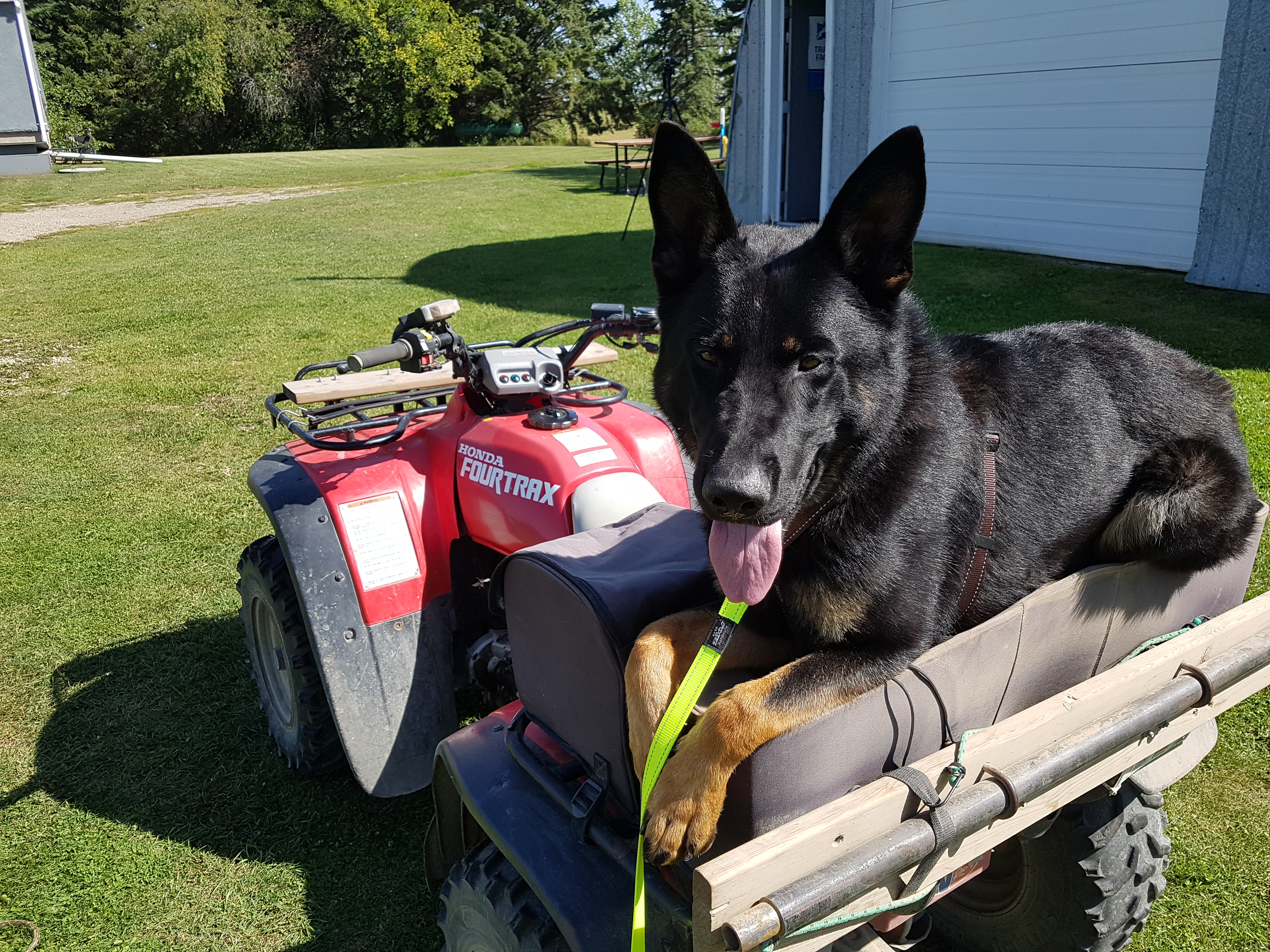
Dog riding a quad.

What is your dream dog? What things would you like your dream dog to know? Most dogs fall way short of their potential. We get some clients that want to go fishing with their dog, others may want a dog that does off-leash heel or a dog you can trust off-leash anywhere. Sometimes we get specialized requests to start them for tracking, diabetes alert or training their own service dog.

There are only a few key components to training your dream dog:

  1. Command itself.
  2. Distractions.
  3. Respect.

Teaching the command itself is often the easiest component. Dogs are smart, you break things down, they learn pretty quick. There are a number of different tricks that will help you break down anything so your dog understands it.

Distractions is another big category. The command often doesn’t take long but now will the dog do it everywhere? Teaching the dog to ignore distractions and focus on the task at hand is one of the biggest challenges people face when training dogs. Some distractions are just really fun for the dog to engage.

The final component is respect. When your dog respects you, wants to please and make you happy, they become a dream to work with. If they want to do things their way and are not too concerned about pleasing you then training can be quite frustrating.

We have a new to us dog that was slated to become an RCMP police dog, his hips didn’t meet the spec for what they like to see so he needed to find a new home. Somewhere that can handle a high drive dog. German Shepherds can become crazy if you don’t know what you are doing. Some are much easier to train than others.

The new dog will be fun, I really like his temperament. Some of the challenges for us are in how the RCMP raise their dogs. Obedience and rules are minimal. Basically the come command is one of the only things that is trained and that is for safety. They are still allowed to jump and bite. Another interesting problem we encountered is they start preliminary bite work training pretty young. So when you get excited and run around he thinks you are a tug toy and he gets to run and bite you.

The first time I had my wife run around with a whistle and waving a stick, you should have seen that guy fire up. Kids running and screaming were also fair game. This is all in prey drive so it is just a game to them. When we went to go see him for the first time the office went to gun run and close a gate, the dog chased after and jumped up to bite him on the arm. The office says “Just so you know, he has started his bite work training.” We are getting him to understand that kids running and screaming is ok and part of everyday life and no you are not allowed to chase them down and bite them. Although as a parent there are days that could be….. Wait a minute, maybe I could have just told the kids they can’t scream when playing otherwise the dog would bite them… Have to rethink my game plan here.

What is my dream dog? I like a dog that knows their obedience to some far distance and high level distractions. Essentially that I can trust the dog off-leash anywhere I want to go. Might teach him to ride on the quad when going down trails. We love doing tracking where we have friends come over, give them a walkie-talkie and tell them to go hide in the field, then we track them down. The kids love playing hide and seek with a dog too. Except for that one time they hid by a giant ant hill and my son kicked the ant hill. By the time we rolled in tracking them we heard screaming and crying and my wife had the boys almost stripped naked brushing the ants off. My oldest son crying saying “This is not the best day ever!”

It’s just fun working on your dream goals with your dog. People often get frustrated because they lack communication with their dog. They might think they are being stubborn when they are not. They might not know how to earn the respect of their dog or how to break the task down A to B.

Helping people achieve their dream dog is what we do. I love it when a client comes in and says “Not sure if we can teach the dog this, but I would love it if they could do this.”

What is your dream dog? What do you want to achieve?

Cold Weather Dog Training – Socializing Puppies

As fall approaches and the temperatures drop it can be much less appealing to head outside and train. If your dog is already trained and socialized properly then you are in the management stage of training and this won’t matter so much.

Puppies are the ones that can suffer the most at this stage if you keep them indoors. They go through a socialization period from roughly 5 weeks of age to 12 weeks of age. Whatever they see within that time and have a good experience with they will tend to like later on. Whatever they have a bad experience or no experience with they will tend to not like later on.

So just by not having seen certain things can cause fear issues in dogs. This is why it is more common for dogs born in the fall or winter to be afraid of thunderstorms. They went through their socialization period not having heard them. This is also an example of why some people will tell me they think their dog is racist, they only bark at black people. This is merely for the fact that the dog often did not see any black people during their socialization period. Same goes for barking at people with walkers or canes, etc.

In the Spring and Summer it is easy to get outside and expose your pup to these things.

So come fall and winter it is still extremely important to socialize. Don’t wait till Spring, you will have missed your chance to take advantage of this critical stage. YouTube is a great way to find all different kinds of sounds. Make sure you still get out to socialize.

If you would like to learn other tips and tricks to make this easier and ensure your dog is very well socialized and trained, come see us. But whatever you do, make sure you socialize your pup. Missing out on this stage can cause huge fear based problems.

You can contact us for training at Tyson@DogSquad.ca

Happy training!

Training Your Own Service Dog in Alberta

There is a great need for service dogs and up until last year you had to go through an approved organization and the wait list could be over 3 years.  The laws have changed to allow a person to challenge the exam with their own dog and have their dog certified.

We get a lot of people contacting us about training their own service dog so we thought this article might be helpful for anyone who would like to train their own service dog. Things you should know that you probably won’t find anywhere else.

In general the dog needs:

  1. Obedience – Should be proficient at their obedience commands.
  2. Distractions – Should be able to perform all obedience commands in the public and to fairly high distractions.
  3. Keeps to themselves and does not engage anyone else of the public.
  4. Stays within 24 inches of the handler unless part of the assistance dictates otherwise.
  5. Can perform 3 or more specialty tasks to help the handler.

One thing to keep in mind is that obedience is one of the easiest parts of training. Most dogs can be taught each obedience command in 5 days tops. From there it is a matter of distraction training where the dog will perform all of these commands in the distractions you would encounter in the public.

When a client comes here for training for a 4 hour session, 99% of dogs can prove they understand recall, heel, sit, down and stay, but that doesn’t mean they will do the commands everywhere. As we show clients when you increase a distraction level, mistakes go up. Then the dog starts to listen and perform well. We then increase the distractions again and the mistakes go up. This pattern will repeat itself all the way through training.

Which Dog To Pick?

Some dogs are going to be much easier than others to train for passing the service dog test in Alberta. Which dog you pick can make or break your chances of having your own trained service dog.

We classify dogs into 3 main types:

  1. Alpha – Top dog, will use aggression to maintain their position.
  2. Beta – Not the top dog but would take over if there is no suitable leader.
  3. Omega – Has no desire to be boss. Always wants to please and follow.

If you are going to train your own service dog, an Omega will give you the best odds of passing the test. Omegas naturally will not go to seek attention from others but they will accept attention from others. Ironically they are the least intelligent of the 3 categories, Alphas are the most intelligent and will give you the most amount of problems.

People mistakenly think they want a smart dog so they are easy to train, in actuality you want a dog with a high desire to please, they are the easiest to train. The saying “I hope I have a smart dog so they are easy to train” stemmed from the days when Force was primarily used for training. If the dog was smart enough they would figure out what you were trying to get them to do before you would break spirit in the dog. They could do the desired behaviour to get the corrections to stop. If the dog wasn’t quite smart enough and you were using forceful corrections you would often break spirit in the dog before they would figure out what you were trying to get them to do. These dogs would often go into avoidance to move away from you to show respect which to some looks like being stubborn so they would correct them harder.

This is why there is still the argument between Force and Reward trainers. It just depends on which category of dog you are working with as to which may be needed.

In order to be an organization that trains or tests service dogs this is the first requirement on the list from the Alberta Training Standard for Organizations to be Eligible for the Qualified List:

“The organization uses training methods that support the ethical and humane treatment of service dogs that do not cause fear, pain or other negative responses in the dog, for example, no shock collar, prong collar or similar equipment is to be used in the training or testing of a service dog.”

That leaves you with the option of Reward Training. The dogs that do best with only Reward Training are Omegas. Once they learn what you want they just want to keep doing that to make you happy.

If you did Reward Training only with a Beta they will learn very quickly but also learn to manipulate. They are smart enough to learn if they do a bad behaviour you will redirect them with a treat or a toy, in essence, rewarding the negative behaviour (we have friends that would offer their child a present when they were throwing a temper tantrum if they behaved – I’ve never seen a child throw so many tantrums and receive so many presents). Betas will need the tiniest bit of consequence to polish off their training but it sounds like none of that is allowed to train your own service dog.

Alphas are out of the question as a service dog. If a dog has shown any aggression towards other people or animals of any kind you would be best to not waste any time training this dog for a service dog position. These dogs are excellent as police dogs and guardian dogs but really unsuited for service dog status.

Ironically we had an organization in Alberta contact us to certify therapy dogs and the requirements were:

  1. 10 years experience as a dog trainer.
  2. Could not be a reward trainer.

Force training will typically give better obedience and respect. Dogs are taught there is a consequence if they don’t do as they are told.

Reward training will give spirit and character. They will be full of personality but they won’t necessarily respect you or have the obedience you wish to achieve (more true for Betas and Alphas but not Omegas).

In many cases when a service dog was being trained a vest would be used on the dog (actually required for service dogs) and the dog was taught when the vest was on the rules were strict and there was a consequence for not following through. Doing this training for a year or more the dog was conditioned to think if the vest was on they were in work mode and the rules were strict. When the vest was taken off they had freedom.

We had a client who paid $16,000 for a service dog out of province for her child (didn’t want to wait 3 years) and the dog was great with vest on but as soon as the vest came off the dog didn’t want to listen, would pull on leash and a list of other undesirable behaviours. She came for training to learn how to get the dog to listen better when the vest was off. This dog was a Beta. She wouldn’t have had an issue if this dog was Omega or possibly very low Beta.

Betas – have desire to challenge, will tug, go up to people, jump on people, nip, engage other dogs, try to take food, pull on leash among other things. All of these things can fail the dog as a service dog.

Omegas – have no desire to challenge, will not tug, do not go up to strangers on their own accord, will not jump on people, will not go up to other dogs, will not easily take food in your presence (often have to look away from them while offering a treat), will follow on leash. They are very naturally suited as a service dog for Alberta.

We specialize in training Betas because if you either use all reward or all force you will cause problems. You have to know the right amounts of each one to use to maintain a happy dog that is respectful and obedient.

The way the laws are written for training your own service dog make it extremely difficult to have a Beta pass the test. They don’t need a lot of consequence but they do need a little. If a person without dog training experience (even with) could train a Beta on their own to pass the test with no consequences we would be extremely impressed.

The Take Away

For the average person we would recommend:

  1. The less intelligent of a dog the better. They don’t have the intelligence to manipulate.
  2. Strong desire to please – Sometimes you can find dogs that have such a strong desire to please and have intelligence. We would call these the “unicorns” almost mythical type creature 🙂
  3. Low energy – They are required to stay with the handler. Typically walking or laying next to them. A highly energetic dog would not be suitable for this.

We have a lot of people contact us who want to train their own service dog for Alberta and already have the dog. Based on the dogs personality, many we can tell would be virtually impossible to have pass the test. So if you are reading this and wanting to train your own service dog make sure you pick the right dog because dogs vary widely in personality and traits. We hate to see people put in a lot of time and effort to only be discouraged when the dog cannot pass the test.

This can be like trying to get a Ferrari to win the Baja 1000 desert race. Fast car, great for some races, but not a desert race.